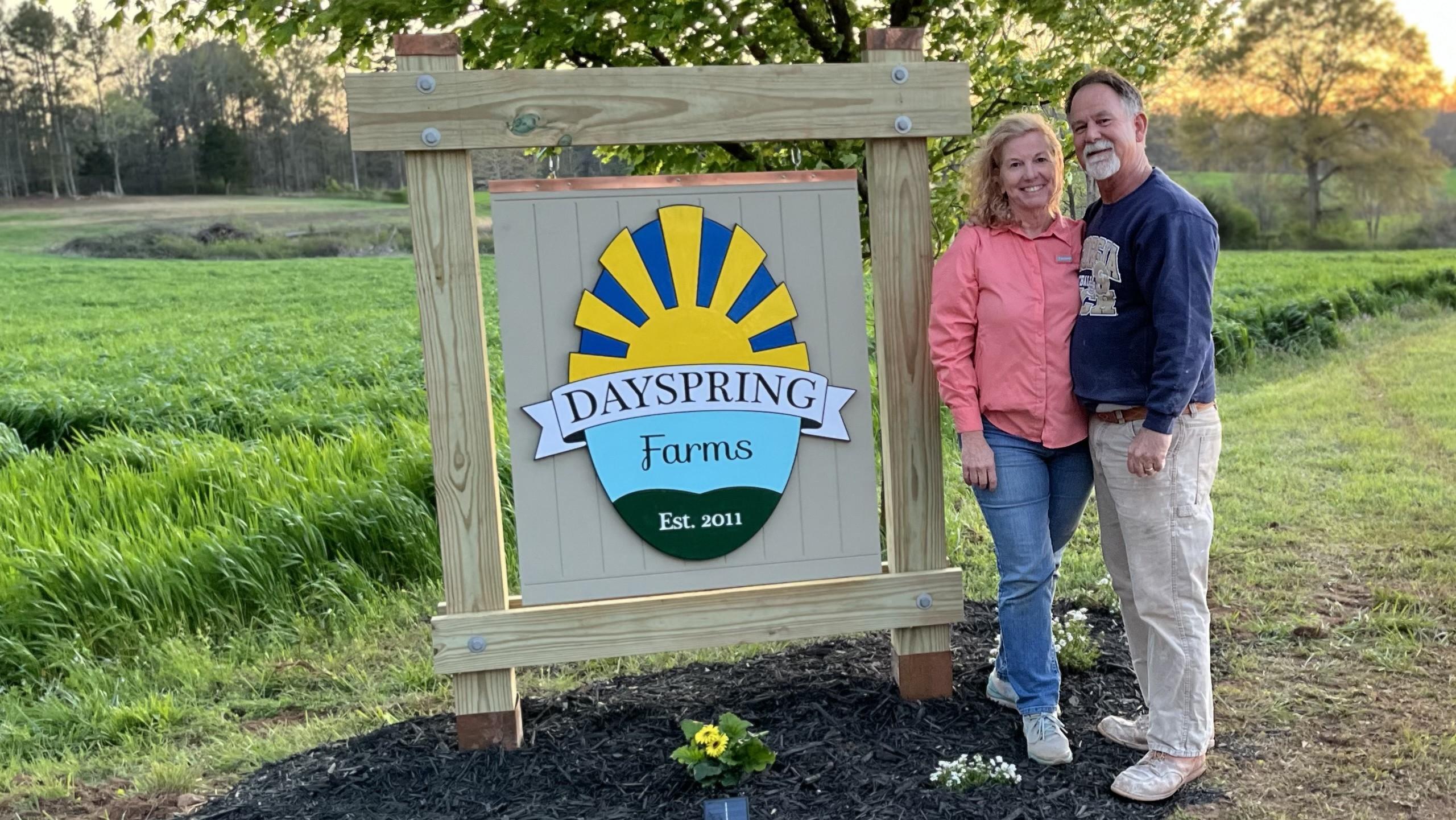
At age 50 in 2011, Murray and Paula Brett had no idea that a second career completely outside their training and experience was in their future. At that time, they had decades in ministry and education. Murray is pastor of Grace Baptist Church in Commerce where he has served since 1997, and Paula spent her career in education teaching Special Education in public school, homeschooling her children and tutoring.
But then, the Brett’s son returned home from Nashville, Tennessee with the idea of growing organic produce to sell at local farmers markets.
“We wanted to support our son as he started this new business,” says Paula. To that end, they purchased 88 acres of cut-over timber land in Madison County, naming it DaySpring Farms. Because the original business plan included raising cattle, Murray planned to plant fescue grass for a pasture and as a ground cover to prevent erosion. When pending cold weather made that impossible, a friend suggested wheat as a cover crop, and a whole other business sprang up.
Learning on the job, Murray and Paula worked with their son on the farm, as they continued pastoring and tutoring, while researching and networking to gain the skills necessary for farming. When the first wheat crop was harvested, Murray sought advice on next steps.
One of the first people to help was Julia Gaskin, Sustainable Agriculture Coordinator at the University of Georgia. “I want to give Julia credit for helping me find a market for my wheat,” said Murray. He credits her with giving him the bible of grain production, The Organic Grain Grower: Small-Scale Holistic Grain production for the Home and Market by Jack Lazur. The book guided the Bretts as they improvised their way into organic farming.
Dewey Lee, a retired UGA wheat specialist, was another early mentor who urged Murray to learn the stages of wheat growth and to follow wheat-production best practices.
“I needed to grow the most harvestable wheat per acre to increase my profits,” explained Murray, who also traveled to North Carolina State University at Lee’s recommendation, where he learned which wheat varieties are more suitable for the eastern United States. .
Over time, as the couple learned more about the business of wheat farming, they bought a small-scale commercial stone mill that Murray refurbished, a gravity table to sort the milled product and a pneumatic sifter to get the desired bran extraction.
Turning a profit
In time, the Bretts began calling on artisan bakers in the Atlanta area, giving them samples of their flour and promoting their process of growing and processing an organic, stone-milled product. Bill Greenwood, of Greenwood’s restaurant in Roswell, became a regular customer and mentor before he closed in 2018.
“He helped me refine my wheat for artisan bakers,” Murray says. By definition, artisan flour has 15% of the bran removed, while pure flour has 28% removed. Greenwood wanted whole wheat flour with just 5% of the coarse bran removed.
Another opportunity arose when a friendship with the brewmaster at Creature Comforts inspired the Bretts to grow a soft white wheat used by distilleries and breweries. That, in turn, led Creature Comforts to create Athena Beer using wheat grown exclusively at DaySpring Farm.
“That was the first year the wheat production turned a profit,” said Murray.
Evolution
Year by year, Paula and Murray continued to find their way in the organic wheat world. Paula took over the office, learning how to use the website and navigate QuickBooks. They narrowed the crops grown to only wheat, corn and peas, no longer growing the more labor-intensive vegetables. They employ a part-time miller and two other part-time employees.
Today the Bretts sell their product to bakeries, restaurants and community-sponsored agricultural cooperatives across the North Georgia area, including Atlanta and even in Chattanooga.
Milled wheat has a short shelf life, requiring the Bretts to operate on a mill-to-order basis. They deliver to commercial customers while retail customers must arrange a pick-up time. Mondays and Tuesdays are milling days. Wednesdays are for deliveries.
“Our customers are more than just business associates, they have become friends,” says Murray, friends like-minded in their love of organic, sustainable food.
Now, at age 65, Murray says retirement is not on his or Paula’s radar. “I don’t want to play golf like my father did when he retired. I feel like I have more to do and we enjoy what we’re doing.”
LHG – Madison chapter members (1-r) Sylvia Clark and Ellen McCally
Ladies Homestead Gathering is a national organization with local chapters.
Cyndi Bal, formerly of Statham,l is the founder of the LHG.
Ladies Homestead Gathering
Keeping Heritage Skills Alive
The mention of homesteading might immediately bring back images of an earlier time and a rural setting. During the 19th and early 20th centuries rural families had backyard gardens, chickens, a few pigs, a cow for milk, maybe a small herd of cattle. Many of our grandmothers canned produce from the garden, gathered eggs, butchered and processed the bird for cooking, baked bread from whole grain flour, sewed the family’s clothes and quilts, and knitted or crocheted blankets.
But in 2026, homesteading refers to a lifestyle focused on self-reliance and living sustainably. It can involve simply growing your own food in a small plot, perhaps raising farm animals on a small acreage or making things at home rather than buying them.
Ladies Homestead Gathering was founded in a farmhouse in nearby Statham. Cyndi Ball’s journey into “homesteading” started when she discovered her daughter was sensitive to chemicals and synthetic materials. She first started making her own soap and from there became interested in self-sufficient living.
“In January 2011, I put out a Facebook post asking if there were any women interested in gathering together to learn more about an independent lifestyle and the skills needed. To my utter surprise and delight, 22 women walked through the front door of my farmhouse! Word spread and in 2013, this small community had grown into a national community. I have often said, if you share knowledge, they will come… and they will stay for the community, a beautiful community of like-minded women,” says Ball, who has since moved from Statham.
Today, it’s a national organization with chapters ranging from Florida to Idaho. In Georgia there are chapters in Clarke, Madison and Wilkes counties.
LHG chapters have a variety of different models, some cater to the urban homesteader, while others are more traditional. Once a month the national board provides a virtual presentation that is available online.
Not everyone has the same goal. One might be the desire for increased self-sufficiency, to be less dependent on grocery stores. Another is the desire to eat more organically grown food and decrease exposure to chemicals. Many are raising animals from heritage breeds that would otherwise be lost as the cattle and poultry industries become more commercialized and streamlined
In February 2017, Madison County women who had been attending classes at Ball’s farm, started their own chapter and followed the original model of in-person gatherings and topic presentation.
Sharing knowledge, building community and growing friendships have been at the core of the organization. Topics at the regular monthly meetings have included experts speaking about the correct pruning of fruit trees, gun safety on the homestead and laws regarding cottage licenses and farm stands.
Local farmers educate the group on the benefits of using fresh produce such as mushrooms and locally grown whole grain wheat. LHG of Madison County supports the local farmers markets and agricultural fairs and cooperates with the local Senior Center’s Meals of Wheels program.
Members regularly give presentations on prepping and freezing meals, fermentation and canning, as well as making tinctures and salves. They share sources for finding fresh vegetables, organic fertilizer, fresh whole milk, farm fresh eggs and locally grown honey. Members support each other in times of need with meal trains, chore swapping and farm maintenance.
In addition to the regular monthly meeting, small groups gather to learn ham radio operation and protocol, sewing classes, foraging for edible plants or plants with health benefits, cleaning cast iron cookware, fire building and emergency first aid.
Although some women may not run their homestead alone, many of them do. Some are single and some have husbands who don’t share a passion for homesteading. LHG provides women support whether they are farming with a family or keeping a homestead alone. Shearing, sheep, building and repairing fences, and rounding up cattle that found greener pastures on someone else’s property are all part of LHG women working together.
The Ladies Homestead Gathering in Madison County has built a community that is going strong as its 10th anniversary approaches in 2027. It’s now one of 21 chapters in 11 states and part of a national non-profit ensuring that homesteading knowledge will be saved for future generations. The Madison County chapter of LHG meets at the Senior Center in Danielsville at 6 p.m. the first Thursday of each month and welcomes women 16 years and older.
Sheryl Knight is a retired physical therapist who lives in Madison County. She now uses her spare time for freelance writing and hiking trails in the many state parks in North Georgia.