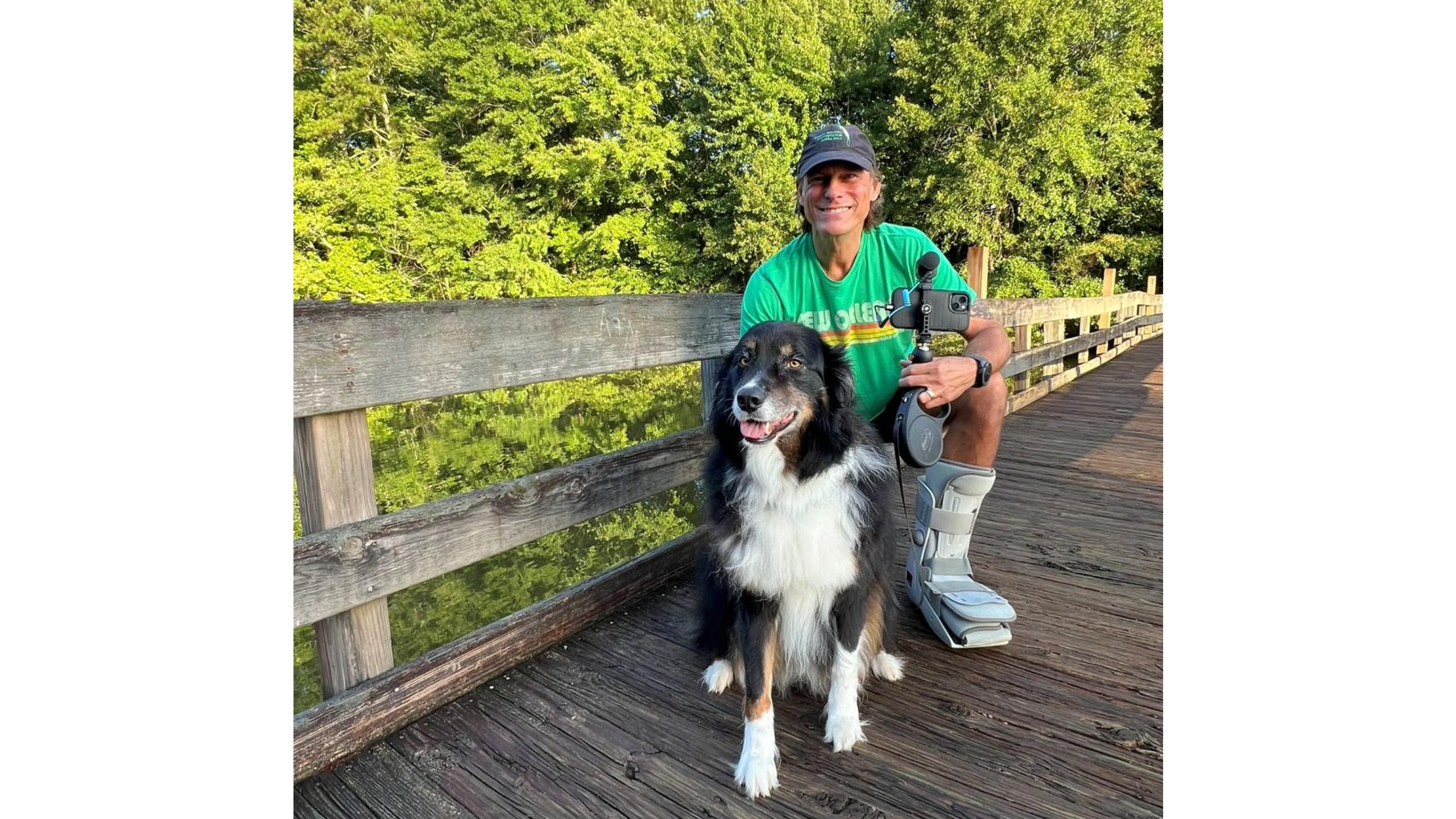
My son started high school cross country summer training at the University of Georgia’s intramural fields in early June, and I decided to walk my dog through the adjacent Oconee Forest while he was running. The Warnell School of Forestry and Natural Resources manages this 60-acre island of 100-year-old oak and hickory forest which offers visitors a well-kept trail system, a challenge course, and a big pond (or a little lake, depending on your perspective). Dog and I watched a fisherwoman excitedly reel in a large bass last week.
As I walked down a moderately open trail – full canopy overstory about 60 feet up, wide as a narrow country dirt road, abandoned railroad tracks amidst the trees, the air around me dancing with the first glimmers of sunrise, I was struck by the birdsong. Nothing I didn’t expect to hear as these birds are commonly seen and heard, but the intricately layered symphony of all the songs woven together was, for me, a sum greater than the individual parts. Some high, some low, some short bursts, some extended background trilling, some belting out the chorus. Far more texture than a Northern Mockingbird parody. I guessed there were at least eight different species engaged in this movement of the morning sonata.
I took out my pocket computer (I’m old enough that sometimes I still marvel that we carry in our pockets a 2-inch x 3-inch x 1/4-inch phone-camera-navigation-biometric tracking device), opened the Merlin app, and grabbed a list and a recording.
Every morning that week from 7-8 a.m., Ozzie, an exuberant 5-year-old Australian Shepherd, and I meandered for 3.5 miles through the forest trails with Merlin recording our adventures. We walked one small loop on pavement through a stretch of tall pines surrounding several open sports fields to finish the circuit. We counted 20-22 species per day and 38 total species during the week, including a pair of Barred Owls who silently watched us – bodies still, heads rotating, eyes locked in on us as we bid them good morning and passed below.
By the end of the week, I had designed my summer experiment. Merlin told me there are 102 bird species that would typically be in the Athens area at this time of year. How many of those might I come across in this 60-acre urban forest island between 7-8 a.m. over the next couple of months? Game on.
Spreadsheet built—species, dates, percent of days seen for each species, notes. New Sennheiser noise canceling external microphone rig added. First day with new mic, 34 species, adding the Indigo Bunting and the Eastern Phoebe to the overall list. Over the next two weeks, I began to see patterns of where the Northern Parula would be found, where the Louisiana Waterthrush might pop by, where the elusive Black-and-White Warbler and Worm-eating Warbler might be if the timing was right. I learned the whistles of the Acadian Flycatcher and how they are different from the Great Crested Flycatcher. What also became clear was just how much noise pollution fills our daily lives—the background “white noise” that drowns out all ranges of birdsong. Blowers, mowers, highway traffic, planes, and pickleball. I grew increasingly sensitive to this sensory environment and aware of the extent to which our human sound footprint overwhelms communication and performance of our feathered companions. I began walking more in the leaf litter on the edges of trails to soften my own footprints as I gathered daily data.
By the end of the second week, Ozzie would give me one lick on the face at about 6:10 a.m., just as dawn was breaking – time to go walking! My son was feeling that he could run forever after this training on top of all the tennis practices. I was on my own high, with 61 total species recorded, and 38-40 species on each day’s list. My spreadsheet was fleshing out with two weeks of data. I had learned to associate many birds with their audible offerings and began to feel a connection with many of the daily regulars—the Mallard family, the Great Blue Heron who played “where’s Waldo” with me along the shoreline, the owls, and a “stinkpot” Common Musk Turtle that Ozzie was very fond of finding in the leaf litter.
Fast-forward. It’s Friday, July 17. I’m 32 field days into my summer experiment. Seven days off for a long weekend in Charleston and two days when other early morning commitments kept me away. My spreadsheet shows 72 of the 102 species, at least according to Merlin. I have two weeks left and hope I might hit 75 by the end of July. Every morning, I start my day thinking how special a little bird-diverse island this forest is, how it’s hidden in plain sight, taken for granted, exploited, yet resilient. As we cross a weathered wooden bridge, guided up the boardwalk toward the courts by a Downy Woodpecker, I want to tell the pickleballers what they’re in the midst of as they fill the air with Wild Turkey-mimicking POPs. The turkeys can tell the difference, although I wonder whether Merlin knows.
7:25 a.m. Happy to hear the Northern Parula again after a week’s absence. Saw a Green Heron fly along the pond’s shoreline and land in a flutter amongst the leaves of a low tree. Merlin didn’t pick it up, but experience brought a little internal smile as I felt confident in my identification. I’m fascinated by herons. A bit later, Merlin heard a Snowy Egret. New ID and one could be here, but I’m dubious and searching for the large white flash to catch my eye and confirm.
The trails were somewhat empty – Friday morning, high school runners taking the day off, other regular dog walkers and runners not yet out. As we stood on the dock, looking across the pond, listening to American Goldfinch and White-eyed Vireo and waiting for the yowl of a Gray Catbird, I said out loud to Ozzie “maybe the Louisiana Waterthrush will show up today, let’s head that way.” No objection from him, alas no waterthrush. “Ozzie, let’s keep going around the pond today.” He thought that was a good idea, and I knew I’d see an Eastern Towhee and had that feeling that a Summer Tanager just might be in the top of the trees on the other side.
Suddenly, my peaceful walk ended with a crash as I hit the ground hard and felt an excruciating pain shoot up my calf and down to my toes. My phone and mic had gone flying and were now separated and strewn on the trail. We were out of the forest and on a clay trail with just a little gravel, at the top of a slight incline. My low-impact birding had turned into a full-contact skirmish, and I was down for the count.
Ozzie licked and walked around me, very concerned. “Good boy. Stay right here with me until I can think straight again.” I was about as far from my car as possible. No one jogged by. I was happy my gracelessness wasn’t witnessed except through the audio recording by Merlin. Merlin — my phone! I scooched on my butt across the trail to retrieve and review the damage. Remarkably, the phone was not cracked. Merlin had dutifully recorded the stream of expletives and was still going. Well, ok, at least I didn’t lose my list today.
I hooked the mic back to the phone, and Ozzie and I began a slow, grueling shuffle back through the forest to my car. A couple more species popped up on Merlin: Cooper’s Hawk and a Brown-headed Cowbird. Small consolation to round out what I knew would be my last morning walkabout for a bit.
Exactly what I did to roll my ankle like this I still do not know, and neither Ozzie nor Merlin is telling. X-Rays show a non-displaced fracture on the tip of my fibula. Doc gave me the boot, literally and figuratively. No weight bearing for at least two weeks. No walking the dog, no forest trails. Sitting in place for an hour to record birdsong eliminates too many of the other elements of this ritual that make it meaningful for me, so we’re hitting the pause button.
This morning ritual over the past six weeks has deepened my appreciation for the importance of urban forest patches in supporting bird diversity. I’ve been graced with soulful serenades, feathered flashes, and aerial acrobatics as the Chimney Swifts swoop and pick off insects from the water’s surface. Meaningful morning hours with my dog walking through the woods … to be continued in October.
Epilog
July 21st. My son is still training and I can still drive, so for the past two days, Merlin and I sat quietly in the parking lot between 7-8 a.m. Ozzie stays home, sad dog eyes when I tell him, “I’m sorry, not today, buddy.”
A curious Carolina Wren hopped on the ground below the open driver’s door and the propped up booted-leg bridge, stopping briefly to rubberneck in curiosity at the carnage. Twenty-five species recorded this morning, including two new ones—a Red-tailed Hawk and a Wood Wren. 75!
Quint Newcomer is director of sustainability and business administration for his wife’s firm, Arcollab. Previously, he was director of UGA Costa Rica.